Showing posts with label Israel. Show all posts

Friday, 6 November 2015

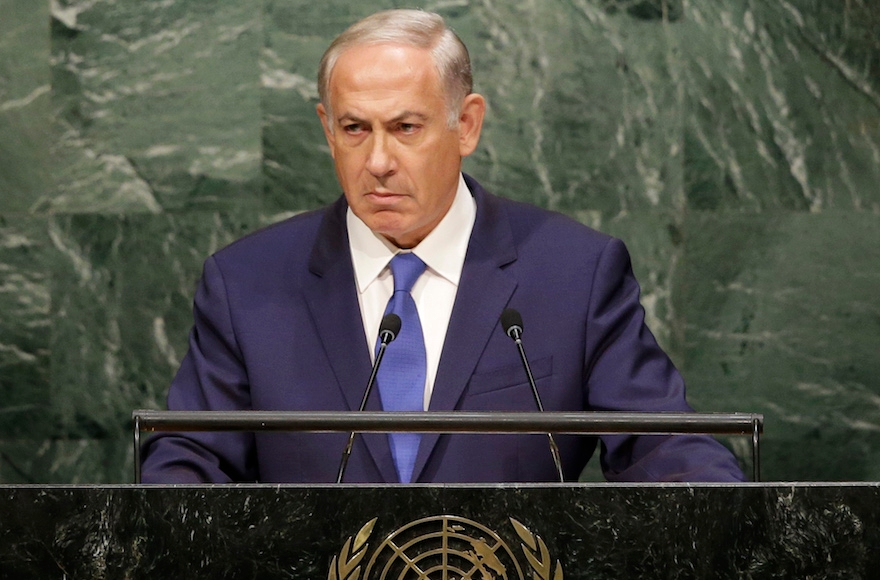
Lies, Damn Lies and Netanyahu Speeches


This post will be a little different from my usual posts.  Instead of using an essay format, I'll use a point-by-point "fact check" format to evaluate Benjamin Netanyahu's recent speech to the UN regarding the Iran nuclear deal and the ongoing Palestinian issue. (To watch the speech, go here)  This post will have two sections.  In the first sections, I'll look at claims that Netanyahu made, that are not strictly speaking false, but are seriously misleading.  Secondly, I'll take a look at some outright falsehoods in the speech.  To ensure fairness to Netanyahu, I've avoided using documentation from sources that are openly anti-Israeli or pro-Palestinian or Iranian (with the single exception of one link to Mondoweiss, which is a pro-Palestinian source).  In fact, careful readers may even note one link to the official website of the Mujahidin i Khalq, a (mostly exile) Iranian dissident group whose opposition to the Iranian regime could hardly be stronger.  One final bit of housekeeping: I've used quotation marks to distinguish Netanyahu's claims from my responses.  The use of quotation marks doesn't necessarily imply that I'm directly quoting Netanyahu, since I've had to condense some of his points. (If you suspect I may have misrepresented him in any way, please feel free to "check my work" by watching the speech for yourself ;) ) So, without further ado, let's begin.

a. Misleading claims

1. "I am prepared to immediately resume direct peace negotiations with the Palestinian Authority without any preconditions whatsoever."
Of course, given that this is a claim about the future (or at least about the Netanyahu government's current intentions for the future), it's impossible to say whether it is true or false.  However, what should be noted is that "no preconditions", coming from the mouth of an Israeli politician, primarily means no guarantee of a halt to settlement growth (as any guarantee would be a "precondition" to negotiations).  Under Netanyahu's leadership, Israel has continued to expand the settlements in the West Bank steadily, and the population of the settlements has grown much more quickly than the population of Israel behind the 1967 borders.  Furthermore, Netanyahu has explicitly stated that he "does not intend to evacuate any settlements." (see here)  Of course, "no preconditions" is supposed to sound reasonable and show Netanyahu's openness to discussion.  In reality, however, it shows Israel's determination to continue to create "facts on the ground" and confine the Palestinians to smaller and smaller "Bantustans" in the West Bank, all the while carrying on the pretense of negotiations intended to create a Palestinian state on the very land the Israelis continue to occupy.
2. "Israel expects the PA to honour its commitments."
It would normally be assumed that someone moralizing in this vein would be representing an entity that had a fairly good record of keeping its own agreements.  However, Israel is one of the most practiced violators of treaties in the Middle East.  To avoid getting bogged down in details, it's enough to note that Israel agreed to withdraw from the entirety of the West Bank and Gaza Strip after the 1967 war, by explicitly agreeing to UN Resolution 242. (See the Wikipedia article here)  This was almost 50 years ago.  Although Israeli representatives have, rather lamely, attempted to argue that, since the resolution reads "withdrawal from lands occupied..." rather than "withdrawal from the lands occupied...", it implies no obligation to withdraw from the entire West Bank.  In addition to the fundamental silliness of this argument, it should be noted that the French text of the resolution contains the definite article, and is equally binding with the English text.
3. "In 2014, the UN passed 20 resolutions against Israel, and only 1 resolution concerning the Syrian crisis, despite the fact that the Syrian civil war has caused far more deaths than the Israeli-Palestinian conflict."
There are two fundamental problems with this claim.  Firstly, it ignores the nature of the UN.  Although the UN, in recent years, has extended its attention to intra-state issues (especially under the Responsibility to Protect doctrine), its fundamental and original purpose is to regulate international relations between states, and particularly to oversee compliance with treaties.  Therefore, the Israeli-Palestinian conflict, involving as it does the occupation of land which is not recognized as part of Israel by international law, lies closer to the UN's core mission than does the Syrian crisis, which is occurring within Syria's internationally recognized borders.  Secondly, counting resolutions is not a particularly good way of measuring the UN's treatment of a given nation.  Instead of looking at resolutions, it would be more helpful to look at practical actions that the UN has taken against a given country.  Looking at matters in this light makes it apparent that, far from being treated worse by the UN than other countries, Israel is actually treated better than average. (How many countries, other than the Great Powers, can so openly disregard the UN, without any practical consequences whatsoever?)

b. Falsehoods

1. "The Christian community in Israel continues to grow and thrive."
Funding for Christian schools in Israel last year only covered 29% of tuition, whereas private, non-state Jewish schools are funded at a level of 100%.  Although, in response to a strike and strong public pressure, the Israeli government has increased funding to Christian schools, this will only allow tuition to be reduced by about 25%, and is only guaranteed for one year. (See here)  Furthermore, since the Christians of Israel are overwhelmingly Arab by ethnicity, they face significant economic and political discrimination (see here and here).  Growing?  Yes.  Thriving? Certainly not in political and economic terms.
2. "Israel respects the religious claims of all."
Israel has failed to extend the protection to Christian and Muslim religious sites that is mandated by its own law. (See here).  Furthermore, Palestinian access to religious sites is often arbitrarily limited. (For one example, see here).
3. "MGen Salehi, Iran's army chief, has promised to 'execute Ayatollah Khamenei's order to destroy Israel.'  This constitutes a threat of genocide."
Salehi said no such thing, nor has Khamenei ever given any such order.  Western politicians and media outlets routinely engage in this sort of misrepresentation.  References to the "Zionist regime" are changed into references to "Israel" as such, then the intention to destroy "Israel" (which was never expressed in the first place) is, without any justification whatsoever, taken to mean an intention to physically annihilate its people. (For one example of the process, see here.  For another, see here, and be sure to notice, within the same article, the switch from "Israel" in the editorial summary to "the Zionist regime" in the direct quote) The first step of this equation is a flat lie.  The second step is an unjustified and unsupported extrapolation.  Even the intention to engage in a war of conquest to destroy a state in no way implies an intention to commit genocide against the people of that state, and, in any case, Iran has never expressed any interest in any such war.  Instead, Iran has held a policy of promoting "regime change" in Israel.  Of course, this is still a hostile and aggressive stance, but it cannot in any way be honestly construed as a "genocidal" or even imperialistic one.
4. "Iran has threatened to topple Jordan"
The actual quote was a response to Jordan's holding a meeting for Iraqi opposition groups, and runs, "Holding such conferences and official sessions in Jordan not only brings no immunity for this country, but in fact it places it on the cliff of insecurity." (See here)  This could, of course, be taken as somewhat menacing, but to (as Netanyahu does) summarize the whole exchange by saying that Iran had threatened to "topple" Jordan is highly dishonest, especially given that no Iranian official has ever explicitly threatened any kind of military action against Jordan.
5. "I remain committed to a vision of two states for two peoples."
Netanyahu has explicitly stated that no Palestinian state will be allowed to exist while he is in power. (See here)  Either he was lying then, or he is lying now.

It's significant that these points are not simply matters of opinion or disagreements concerning interpretation.  They are simple matters of fact, which Netanyahu routinely distorts to achieve his political objectives.  If he is this unreliable in regard to issues we can check and verify, what should we make of his statements regarding issues that are not open to this kind of public verification?

Sunday, 13 September 2015

Why China is Dangerous


Over the past few years, the rise of China has been a constant topic in discussions of international politics.  Although China is experiencing an economic downturn at present, which presents some difficulties for the continued growth of its power, this is likely a cyclical phenomenon, and even a moderate rate of economic growth, when combined with China's massive population, would provide a solid basis for China to become easily the preeminent power in Asia.  At the same time, China has been devoting an increasingly large slice of this increasingly large economic pie to military spending, which has been growing by more than 10% per year in recent years (see here).  These facts have produced a burst of confidence in the People's Liberation Army.  In his book, America's Coming War with China, Ted Galen Carpenter quotes Michael Pillsbury's study, which notes that the PLA has produced over 200 studies of possible wars with the United States, and not one of those studies admits the existence of any scenario in which an American victory is likely.  
This confidence has been displayed in ever more aggressive actions in the South China Sea.  After drilling for oil in disputed waters near the Paracel Islands last year (an action which led to violent protests in Vietnam), China has returned to drill again in the same area this summer (see here).  Earlier this year, China carried out large-scale land reclamation activities in the disputed Spratly Islands (see here).  In response to the accusation that China was "bullying" smaller countries, a Chinese spokesperson denied the charge, but also further commented that small countries should avoid "unreasonable demands". (See here)  Although it could be claimed that this comment is merely stating a fairly unobjectionable principle (Presumably few people would argue that any country should be unreasonable), it's difficult to avoid noticing that China explicitly states this as an obligation specifically applying to small countries.  The unstated implication seems to be that small countries should expect to be moderately bullied, and not be so "unreasonable" as to expect true Great Powers (like China) to treat them as genuine equals.  This impression is further reinforced by China's refusal to submit any of its claims to legal arbitration, or to engage in any sort of multilateral discussions, preferring bilateral discussions where China's superior power can be brought to bear against each small country individually.
This kind of behaviour is further rooted in a pattern of international relations rooted in China's ancient past.  As Edward Luttwak notes in his book, The Rise of China vs. the Logic of Strategy, a narrative has taken root in China's Communist Party according to which China is entitled not only to the revision of its semi-colonized status of the 19th and early 20th centuries, but to the full restoration of its status as the "Middle Kingdom" with hegemonic power in East Asia.  In this view of international relations, there is no room for any recognition of other Asian states as fully equal to China, nor is there room for any real respect (as opposed to tactical acquiescence) for international institutions.  Although this does not imply any Chinese ambition to interfere with or control the internal affairs of other countries, it does imply that, in the international arena and when dealing with regional Asian Pacific issues, China's voice should be the loudest and have the final say.
However, in the final analysis, China's strength isn't the primary reason why China is dangerous.  Whatever the pretensions of the writers of PLA strategic studies, the Chinese military is no match for the United States Navy and Air Force, much less for the combined forces of America, Japan, Australia and the ASEAN nations.  Any decisive Chinese move for truly hegemonic power in Asia would be self-defeating.  Although China can continue to build its power by the kind of creeping encroachments it has been engaging in lately, these kinds of actions will never add up to a foundation for truly hegemonic power in the region.  A rational China is likely no more than a manageable threat to the Asian Pacific equilibrium.  What makes China dangerous is the risk that it may act irrationally, a risk that is presented not so much by China's strength as by its weakness.  This weakness is primarily seen in three areas.
The first area of weakness is the environment.  China's air pollution is notorious, and is getting worse.  It has been estimated that air pollution is reducing life expectancy in the north of the country by 5.5 years, and (as of 2008) was reducing China's Gross National Income by 9% (see here).  What is not as well-known is that China also has major problems with water pollution.  It has already been estimated that two thirds of China's cities are suffering from a shortage of clean water.  Again, this problem will certainly get worse before it gets better.
The second area of weakness is ethnic tensions.  Xinjiang and the Tibetan Autonomous Region are both fertile seedbeds of ethnic tension, which threaten both China's internal stability and its relationships with the countries of Central Asia (most of whose populations are ethnically related to the Turkic Uyghurs of Xinjiang).  In both cases, ethnic tensions are aggravated as well by the Communist Party's repressive religious policies toward Tibetan Buddhism and Islam in Xinjiang.  Although it has not been confirmed, it is possible that these tensions have even had major effects beyond the borders of China.  The investigation into the recent bombing of the Erawan shrine in Bangkok has unearthed considerable evidence that the motive behind the attack may have been anger at the Thai government for forcibly repatriating Uyghur refugees to China (see here).  Again, this problem seems to be one that, even in the best case scenario, will get worse before it gets better.
These first two problems, although serious, are probably manageable.  Although dealing with the environmental crisis will have major economic costs, and ethnic tensions will threaten the internal stability of China, there are remedies that the Chinese government can apply to deal with these problems.  However, there is a third problem which, in addition to being extremely serious, is beyond the regime's problem to solve in the short, or even the medium, term.  This problem is China's looming demographic crisis.  Since the introduction of the one-child policy in the 1980's, China has had a very low birthrate.  As a result of this low birthrate, China's population is aging rapidly.  In 2012, China passed an important tipping point as the working-age population began to shrink (see here).  Since China's birthrate remains very low, for the foreseeable future an ever diminishing group of working age people will have to support an ever increasing group of retirees.  Furthermore, this transition has to be made in a situation where China's economy is still relatively undeveloped.  Although China has a very high total GDP, due to its large population, its GDP per capita is still relatively low.  This means that the resources available to care for this growing army of retirees are quite limited.  Other countries that have had to make similar transitions, such as Japan and Germany, have had to do so from a much higher economic level.  China will have to make this transition with much more limited resources, while simultaneously trying to contain severe ethnic tensions and deal with an environmental crisis of near-apocalyptic proportions.  On top of all this, there is nothing China can do to reduce these strains.  China is not an attractive destination for immigrants, and attempts to increase the birthrate by relaxing the one-child policy have largely failed.  Even were such efforts successful, it would take the better part of 20 years for them to have any effect on the size of the workforce.  Even in the best-case scenario (which, given the failure of the birthrate to rebound since the relaxing of the one-child policy, is extremely unlikely), China is doomed to a decades-long decline in its economic, and therefore its military, potential.
Given the previously-mentioned confidence of the PLA, it seems that the penny hasn't yet dropped for the Chinese leadership.  Whether or not the current economic downturn successfully draws the regime's attention to its own weaknesses, such a realization must occur at some point, probably within the next ten years.  When this occurs, there is no telling how China's leadership may react.  A regime that has told both itself and its people that it is entitled to (and will inevitably achieve) the leadership of the Asia Pacific region, will have to face the possibility of a turn inwards and an almost complete abandonment of its foreign policy ambitions.  Given the degree to which the Chinese regime has stoked aggressive nationalism in the Chinese population, it is highly doubtful whether the regime can make such a turn while maintaining its legitimacy.  The temptation will be extremely strong to make a decisive move, either against Taiwan or in the South China Sea, while such a move still seems possible.  It is not the Chinese regime's current confidence, but its future desperation, that should be a major concern to the rest of the world.

Saturday, 15 August 2015

Why Norman Finkelstein is both right and wrong about BDS

In an extremely interesting episode of Al Jazeera's Head to Head program at the end of last year (Watch it here), Norman Finkelstein took on a panel of mostly One-State Solution advocates over his opposition to the BDS movement. Although Finkelstein doesn't himself make this distinction clearly, it seems that he makes two separate arguments. The first is that BDS opposes international law by tacitly opposing Israel's right to self-determination as an internationally-recognized state. The second is that BDS risks de-legitimizing the Palestinian cause by demanding a solution that is too far from the mainstream of international opinion.

In making the first claim, Finkelstein is clearly wrong. The BDS makes three demands, Israel's withdrawal from all territory occupied in 1967, the granting of full and effective equality to Israel's Arab population, and the "right of return" for the Arab refugees of 1948,as demanded by UN resolutions on the status of refugees. The problem for Finkelstein is that all three of these demands are clearly in line with international law and UN resolutions. The "right of return" has been supported in explicit connection with the Palestinian issue by past resolutions, and the Arabs' right to equality is covered by the UN Declaration of Human Rights. Finkelstein, however, argues that these three demands (particularly the right of return) mean the end of Israel as a Jewish state. This is likely true, given that the full implementation of the right of return would lead to a majority-Arab Israel. However, this is no problem under international law. The fact that Israel is a legally recognized entity within its 1967 borders does not give Israel the right to violate international law to maintain a certain ethnic character. What international law recognizes is not Jewish Israel or majority-Jewish Israel, but simply Israel. In the same way, Apartheid South Africa's recognition as a state in no way implied a right for the country to exist as a specifically white state. The difference between Apartheid and post-Apartheid South Africa is just as great as the difference between Jewish and post-Jewish Israel would be. In neither case does this difference imply a violation of the state's right to exist under international law.

However, the legality of the One-State Solution is a different matter from its feasibility. On this question, Finkelstein is on much firmer ground. Whenever Finkelstein is challenged by One-State Solution advocates, he asks them to name one country that has come out in support of this solution. In repeated UN votes, virtually the entire world has lined up behind the Two-State Solution, but not one country has supported the One-State Solution. One-State advocates have argued that world opinion can change, which is true, but the question is how long this will take. There are no guarantees, and in the meantime Palestine continues to be ground down, and its people continue to suffer. Politics is the art of the possible, and, as is often the case, there is a serious risk here that the best may become the enemy of the good.

One more question that needs to be addressed in this connection is the situation of the Israeli Arabs. One-State advocates have expressed concern that a Two-State Solution may lead to pressure on the Israeli Arabs to emigrate to Palestine and increased discrimination. In the short-term, I think this is likely true. However, no one can force the Israeli Arabs to leave if they don't want to. An international community that had been mobilized enough to force a Two-State Solution would never stand by while the Israeli Arabs were ethnically cleansed. All the possibilities for civil rights advocacy would still be there, and, over the long term, the defusing of the tensions caused by the occupation might even create conditions more conducive to the achievement of Arab equality in Israel. But first things first. The occupation needs to end.